

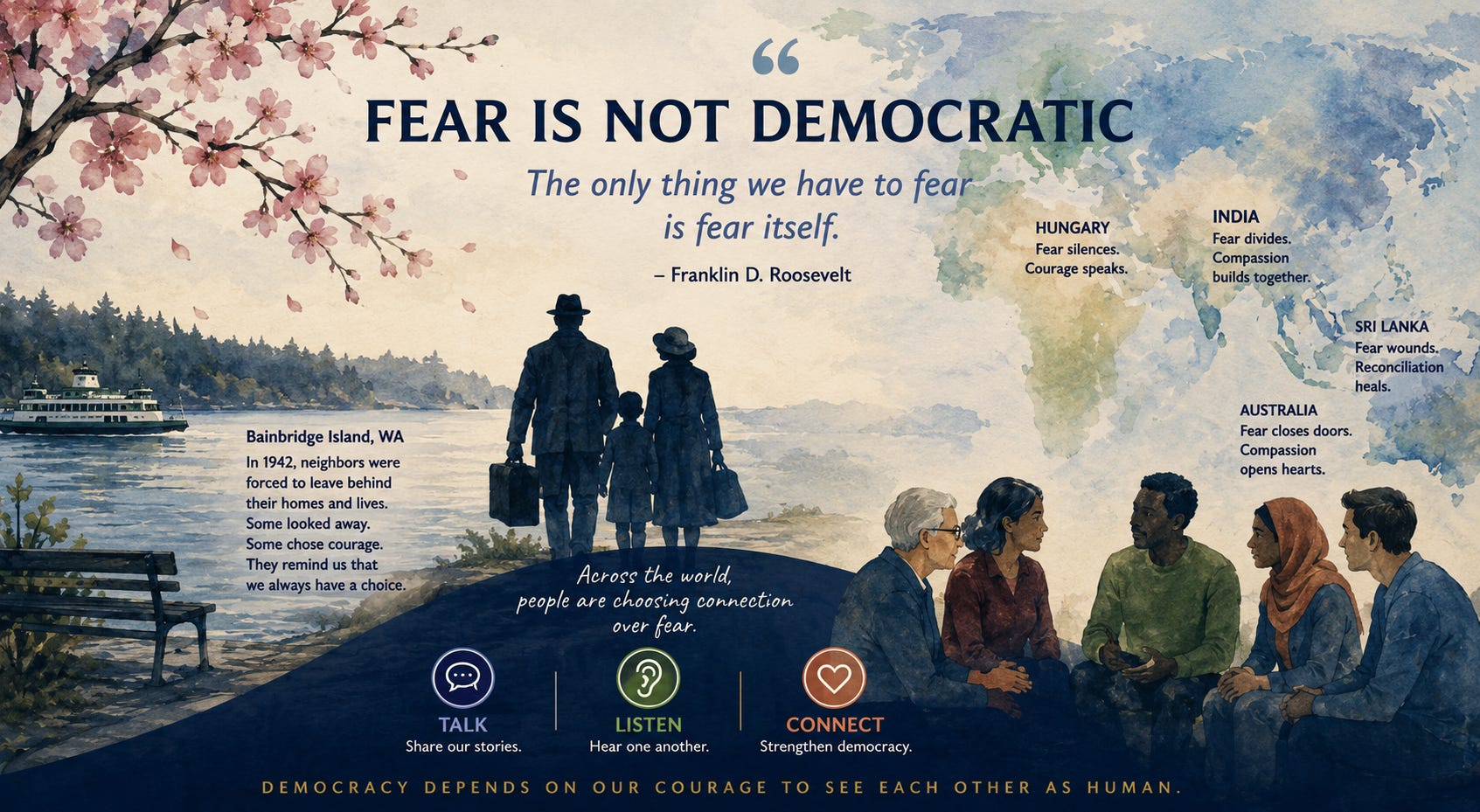
“The only thing we have to fear is fear itself.”
— Franklin D. Roosevelt
For years, I lived on Bainbridge Island, a beautiful island community in the Pacific Northwest known for its forests, shoreline, and close-knit sense of place. But Bainbridge also carries another history. It was the first community in the United States where Japanese Americans were forcibly removed following Executive Order 9066, signed by Franklin D. Roosevelt during World War II. Families were given only days to leave their homes, businesses, farms, and possessions behind. Many had lived on the island for decades. They were neighbors, classmates, merchants, farmers, and friends.
And suddenly, fear transformed them into suspects.
The story of that time lives not only in historical memory, but also in literature through Snow Falling on Cedars, which captured the atmosphere of suspicion, silence, prejudice, and unresolved grief that lingered long after the war itself had ended.
What has always stayed with me is that Bainbridge Islanders faced a choice. Some remained silent. Some accepted the government’s actions out of fear or wartime loyalty. But others chose differently. A small number of citizens publicly challenged the injustice, supported their Japanese American neighbors, safeguarded property, and welcomed families back after the war ended. Even in a climate shaped by fear, they insisted on recognizing the humanity of those around them.
That matters. Because democracies are often tested not only by what governments do—but by how ordinary citizens respond. And yet, there is another difficult truth in this story.
The very president who warned Americans that “the only thing we have to fear is fear itself” ultimately yielded to fear himself. Roosevelt’s leadership during the Depression helped steady a frightened nation. But during wartime, fear of espionage, racial prejudice, political pressure, and national insecurity contributed to his decision to authorize the internment of more than 120,000 Japanese Americans—most of them U.S. citizens.
Decades later, the United States formally acknowledged that internment had not been justified by military necessity, but had resulted from “race prejudice, war hysteria, and a failure of political leadership.” Those words remain painfully important. Because they remind us that fear does not only affect ordinary citizens.
Fear can shape institutions, governments and leaders themselves.
Throughout history, many of the darkest political movements have depended on fear. Fear of outsiders, economic collapse. fear of racial, religious, or cultural difference and fear that “others” are threatening the identity or survival of a nation.
In Germany during the rise of Nazism, fear and humiliation following World War I were manipulated into resentment and hatred toward Jews, immigrants, intellectuals, LGBTQ+ people, and political opponents.
In periods of anti-communist hysteria in the United States, fear created suspicion strong enough to destroy reputations and silence dissent. In Rwanda, fear-based propaganda inflamed division and ultimately fueled genocide. And in many countries today, fear continues to be used politically—fear of migrants, fear of minorities, fear of journalists, fear of difference itself.
We can see this struggle unfolding globally in many different forms.
In Hungary, many citizens have continued to resist the slow erosion of democratic norms, even as fear and polarization have increased pressure on independent institutions and public discourse. Journalists, educators, community organizers, and ordinary citizens have continued insisting that democracy is worth defending.
In India, tensions surrounding religion, identity, and nationalism have at times fueled fear between communities that have lived alongside one another for generations. Political rhetoric and social media have sometimes deepened suspicion toward minorities, particularly Muslims and Christians.
And yet India also offers another story—one of resilience, pluralism, and courageous civic engagement. Across the country, countless citizens and grassroots organizations continue working to preserve communal harmony and democratic values.
In Sri Lanka, decades of ethnic tension between Sinhalese and Tamil communities were intensified through fear, political manipulation, and violence, contributing to a devastating civil war that lasted more than twenty-five years.
Fear hardened identities. It deepened the mistrust. And it left trauma that still echoes across generations. But even there, many Sri Lankans continue the difficult work of reconciliation and coexistence.
Today, fear also shapes public policy around migration and refugees.
In Australia, years of debate over asylum seekers arriving by boat led to offshore detention policies that many human rights organizations argued caused profound psychological suffering and dehumanized vulnerable people seeking safety.
Across Europe, North America, Asia, and beyond, refugee movements are increasingly framed through the language of threat rather than shared humanity.
Fear narrows compassion. It divides the world into “us” and “them.” And once fear becomes normalized, rights that once seemed secure can erode surprisingly quickly.
This is why fear is not democratic. Democracy depends on participation, trust, dialogue, and shared responsibility.
Fear pushes in the opposite direction: toward silence, suspicion, withdrawal, and toward strong-arm politics that promise certainty at the expense of freedom.
At the Charter for Compassion, we have increasingly come to understand that responding to fear requires more than political argument. It requires rebuilding relationship.
Through the Compassion Transformation Institute, we are exploring practices that strengthen emotional resilience, compassion, and connection. Programs such as TLC—Talk, Listen, Connect begin with simple human encounters. People are invited to share what they love, the gifts they carry, and the experiences that shape them.
These may seem like small acts. But they matter because fear thrives where people stop knowing one another.
Because fear is not merely political. It is physiological. It affects the nervous system.
It shapes how we respond to uncertainty, difference, and change. If we do not learn how to work with fear wisely, fear will continue to shape our democracies for us.
None of this means fear disappears. Courage is not the absence of fear. It is the refusal to let fear make all of our decisions. Across the world today—from Bainbridge Island to Hungary, from India and Sri Lanka to Australia and the United States—people continue to face the same essential question: Will fear define how we see one another? Or will we choose something else?
Fear will always exist. But so will compassion. So will courage. As will the human capacity to choose connection over division. Democracy depends on which of these we decide to cultivate.
And perhaps Roosevelt’s words still matter because they remind us of something enduring: Fear itself becomes dangerous when we stop questioning it, stop resisting it, and allow it to govern how we see one another. That is when democracy begins to weaken. And that is why fear is not democratic.